Exhibitions
The highlights of the Palais
Tuesday to Friday from 10 am to 5:30 pm, Saturday and Sunday from 10 am to 7 pm.
Tuesday to Friday from 10 am to 5:30 pm, Saturday and Sunday from 10 am to 7 pm.
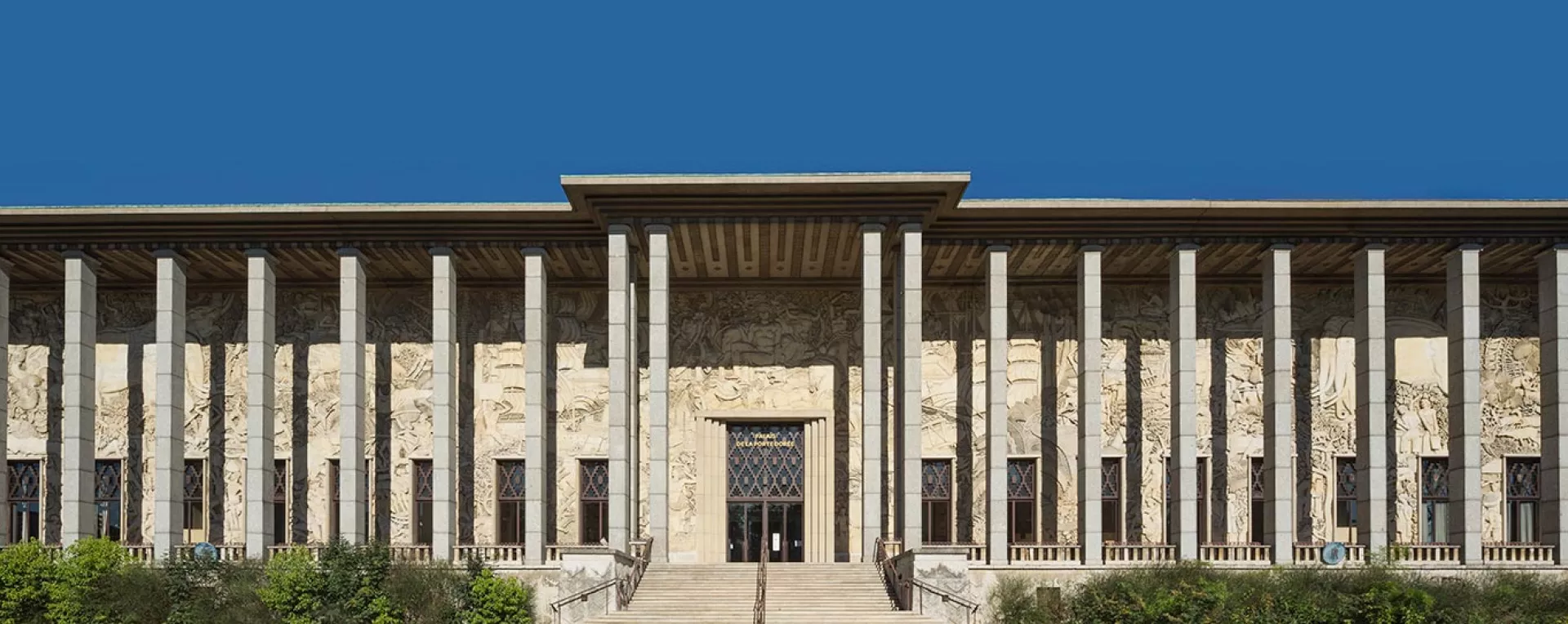
From its entrance gates to its light fixtures, including its monumental bas-relief, the Palais de la Porte Dorée, now listed as a historic monument, can be discovered through a journey combining art, history and memory.
There are several ways to discover the Palais de la Porte Dorée. While every detail of the building reveals the talent of some of the greatest Art Deco artists, the structure also bears the imprint of the colonial project, of which it was one of the leading symbols in the 1930s. Remarkable for its architecture yet complex in its history, it remains an essential testament to an important chapter in France’s national history.
This tour invites you to explore its decorative features and architecture while comparing the discourse of the past with a critical, contemporary perspective.
Designed by architect Albert Laprade for the 1931 International Colonial Exhibition, the Palais is an iconic example of Art Deco architecture. It incorporates the movement’s main characteristics: symmetrical spaces, geometric forms and clean lines, minimalist design, colonnades, spacious interiors, the use of reinforced concrete, and more.
The visit begins outside, on Place Édouard Renard, with Léon Drivier’s statue of France, before continuing towards the entrance of the Palais, at the foot of the world's largest sculpted bas-relief.
Created in 1931 by sculptor Léon-Ernest Drivier for the Musée permanent des Colonies, this gilded bronze statue was originally intended to be created by Antoine Bourdelle, who died before the project could be completed.
Initially placed in front of the Palais de la Porte Dorée’s grand staircase, it now stands a few metres away, on Place Édouard-Renard. Its relocation was due in part to the difficult relationship between Drivier and the Palais’s architect, Albert Laprade.

Léon Drivier’s statue “La France” at the centre of Place Édouard-Renard.
© Palais de la Porte Dorée
The four monumental lionesses at the entrance to the Palais de la Porte Dorée were designed by sculptor Henri Navarre. They draw on the tradition of guardian animals while embracing a distinctly modern and minimalist aesthetic.
Perched atop their pillars since 1931, they symbolically stand guard over the monument. Their poised silhouettes and stylised strength enhance the monumental impact of the building’s Art Deco architecture. Designed as striking visual landmarks, they embody strength, elegance and the interplay between sculpture and architecture.

Two lionesses by sculptor Henri Navarre at the entrance to the Palais de la Porte Dorée.
Cyril Zannettacci © Palais de la Porte Dorée
Located between Avenue Daumesnil and the Palais forecourt, the main entrance gate was designed by Jean Prouvé, the renowned metalworker and designer from Nancy. During the 1950s, he worked with Le Corbusier and, in particular, Charlotte Perriand, with whom he later co-founded the École nationale supérieure de création industrielle (ENSCI – Les Ateliers) in 1982.
An architect as well as a designer, Prouvé was the first to introduce aluminium into building construction.

The entrance gate of the Palais de la Porte Dorée, designed by Jean Prouvé.
Pascal Lemaître © Palais de la Porte Dorée © ADAGP, Paris, 2022
Created in less than two years by Alfred Auguste Janniot, a renowned sculptor celebrated for his monumental decorative works, this vast “stone tapestry”, covering 1,130 square metres, is the largest bas-relief in the world. Covering the entire façade of the Palais de la Porte Dorée, it celebrates the wealth that the French colonial empire derived from its colonies, while obscuring the realities of domination, exploitation and inequality inherent in the colonial system. Its primary objective? To persuade a public that was largely indifferent to the French imperial project.

Alfred Janniot’s bas-relief above the entrance to the Palais de la Porte Dorée.
Anne Volery © Palais de la Porte Dorée
The visit continues inside the Palais, revealing an exceptional panorama of 1930s decorative arts. Designed by Albert Laprade (1883–1978), the building was conceived as a total work of art, in which architecture, furniture and decorative elements are in constant dialogue.
From floor to ceiling, visitors encounter creations by some of the greatest artists and designers of the period, including Jacques-Émile Ruhlmann, Eugène Printz, Raymond Subes, Edgar Brandt, Jean Dunand and Gilbert Poillerat.
The historic interiors and decorative features can be explored freely and free of charge throughout the visitor route. The only exception is the Lacquer Room (Salon des laques), located on the third floor of the Palais, which requires a museum admission ticket.
Enter the monument’s central hall: its impressive height, lighting, materials and decorative features create a spectacular effect, perfectly illustrating the Art Deco aesthetic.
What to look out for:

View of the entrance to the Hall of Honour, featuring the wrought-iron work by Raymond Subes.
Nicolas Borel © Palais de la Porte Dorée
Continue your visit with the two grand reception rooms, located on either side of the Palace’s Hall of Honour. Both have been listed as Historic Monuments since 1987. Located to the left of the entrance, the room known as the “Africa salon” originally served as the reception office of the Minister of the Colonies, Paul Reynaud, during the 1931 Colonial Exhibition.
The interior design was entrusted to one of the leading figures of the Art Deco movement, Jacques-Émile Ruhlmann, who created a complete, harmonious ensemble, from the marquetry flooring to the luxurious furniture.
Learn more about the Africa salon
The “Asia Room”, meanwhile, originally served as the office of Marshal Lyautey, Commissioner-General of the 1931 Colonial Exhibition. Another leading figure of the Art Deco movement was commissioned to design its interior: Eugène Printz. The wall frescoes, created by André and Ivana Lemaître, depict the philosophical and artistic contributions of Asia to France.

The Africa salon
Lorenzö © Palais de la Porte Dorée
The central room of the Palace, known as the Forum, formerly the “function room” during the 1931 Colonial Exhibition, houses a monumental 600 m² fresco painted by Pierre-Henri Ducos de la Haille.
The commission had a specific purpose : to illustrate what France presented as its intellectual and moral contribution to its colonies, with the aim of promoting and glorifying the colonial enterprise.
Conceived as a celebration and propaganda tool, this decorative scheme helped promote a favourable image of colonialism. It presents an idealised vision of France’s overseas presence, while overlooking the power imbalances, forms of exploitation and violence that accompanied the colonial enterprise.

Central fresco in the Forum of the Palais de la Porte Dorée by Pierre-Henri Étienne Ducos de la Haille.
Lorenzö © Palais de la Porte Dorée © ADAGP, Paris, 2018
Head up to the third floor to discover the lacquer room, the former library of the Colonial Museum, which was reconstructed in 2023.
Designed in 1931 by Albert Laprade, the Palace’s architect, as a space to welcome visitors to the Colonial Museum, the room has now been restored to its original splendour. It once again features its Madagascar rosewood furniture, listed as a Historic Monument, along with the lacquer panels by the exceptionally talented artist Jean Dunand, which originally adorned the room.
This remarkable combination of furniture and decorative art offers another outstanding example of the Art Deco style.
Please note : Access to the Lacquer Room requires an admission ticket to the museum.

The lacquer room
Cyril Zannettaci © Palais de la Porte Dorée
